In-service Training
New Mexico Law Enforcement In-Service Requirements
In-service law enforcement training consists of at least forty (40) hours of academic instruction, approved by the council, for each certified police officer during each twenty-four-month period of employment or service. The first training course shall commence no later than twelve months after graduation from an approved basic law enforcement training program.
In-service telecommunicator training consists of at least twenty (20) hours of board-approved advanced training, including one hour of crisis management, including crisis intervention, confrontation de-escalation practicum and proper interaction with persons with mental impairments training, for each certified telecommunicator during each two-year period. The first training course shall commence no later than twelve months after graduation from a board-approved basic telecommunicator training program.
2026-2027 Reporting Requirements
All certified individuals shall provide proof of completing in-service law enforcement training requirements to the Director no later than March 1st of the year in which the requirements must be met.
Individuals obtaining certification within an even numbered year will be required to obtain one-half of the in-service training requirements. Individuals obtaining certification within an odd numbered year will be required to meet the next two-year in-service training requirement which will go into effect on January 1 of the succeeding even numbered year. The in-service training requirements are applicable in subsequent two-year cycles (one even number year and the subsequent odd numbered year constitutes a two-year cycle). Individuals transferring from one agency to another will carry with them the responsibility for in-service training.
Reporting Forms
In-service training reporting is due quarterly as required by §29-7-7.2 NMSA 1978. Agencies shall use approved NMLEAB forms for reporting purposes. Current approved reporting forms to report mandatory in-service training required by §10.29.7.8 NMAC and §10.29.7.9 NMAC, are:
**These forms can be found on the Forms and Documents page and MUST be mailed to the NMLEA at the address listed on the top of the form NO LATER THAN March 1 of each reporting year (2026 is due 03/01/2027; and 2027 is due 03/01/2028).**
Changes to 2024-2025 Biennium Requirements
Effective January 1, 2024, the new statutory requirements of §29-7-4.4 NMSA 1978 and §29-7C-4.1 NMSA 1978 have been incorporated into the compliance reporting cycle. These topics are ANNUAL requirements, and will need to be taken once during the 2026 calendar year and once during the 2027 calendar year.
The NMLEA has broken-down the requirements in the following visualization tables to help understand the quantity and frequency of each specified required topic listed in the Law Enforcement Training Act (§29-7-et. al NMSA 1978).
Police Officer Requirements
Please note that due to the minimum total hours for all statute specified annual and biennial topics exceeding 40 hours, “Remaining training hours shall be in maintenance or advanced areas to meet the agencies specific needs” as described in §10.29.7.8, Paragraph A, Subparagraph (12) NMAC, is no longer necessary to fulfill the requirement, “In-service law enforcement training consists of a minimum of forty hours of academic instruction approved by the council for each certified police officer during each twenty-four month period of employment or service with a state or local law enforcement agency…” as prescribed by §29-7-7.1 NMSA 1978 for law enforcement officers.
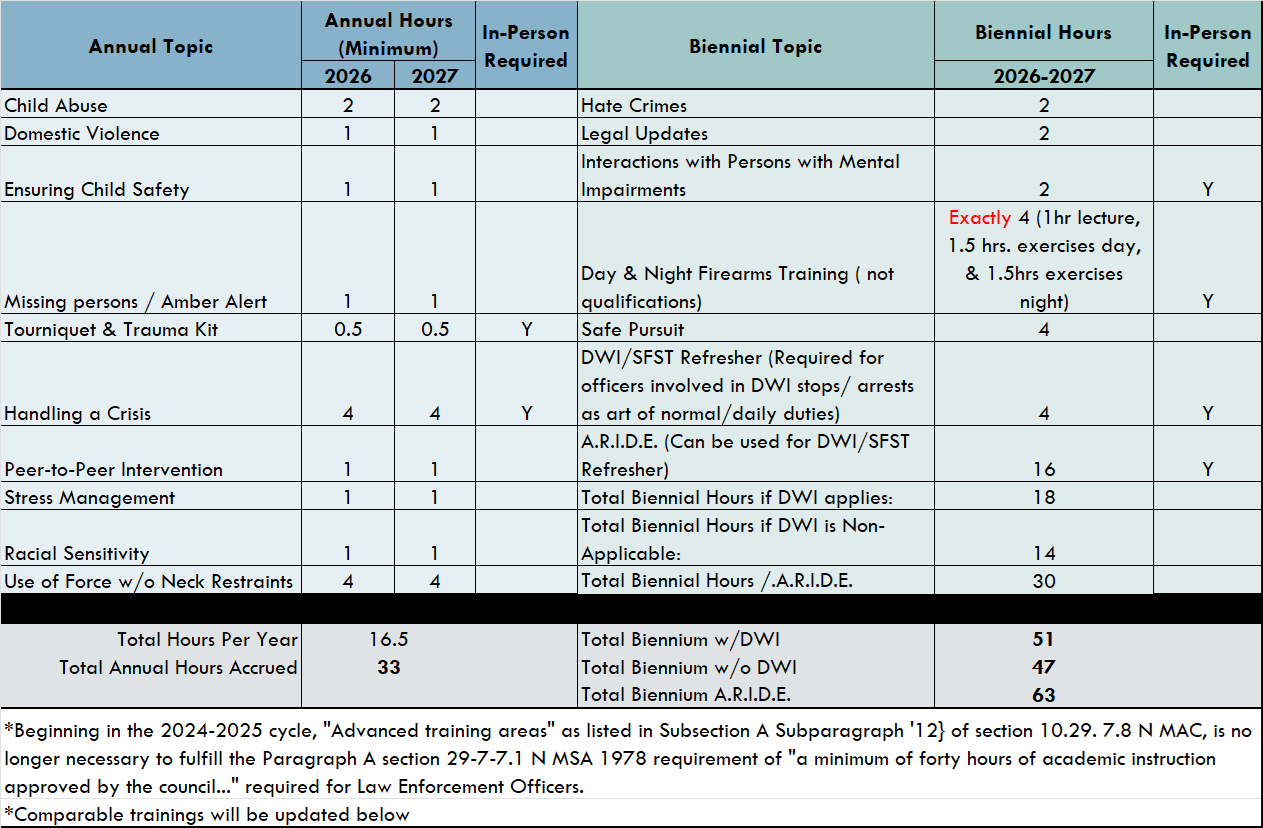
*In-Person denotes that the course MUST be taken in-person due to a component of the requirement for scenarios or practical application. Online courses will NOT count for these topics.[/caption]
Public Safety Telecommunicator Requirements
Please note that Public Safety Telecommunicators must still fulfill a minimum of 4 “Remaining training hours shall be in maintenance or advanced training areas to meet the agency’s specific needs and abilities of the telecommunicator” as described in §10.29.7.9, Paragraph A, Subparagraph (2) NMAC, by seeking NM Law Enforcement Certification Board-approved accredited courses pursuant to §29-7C-7 NMSA 1978.
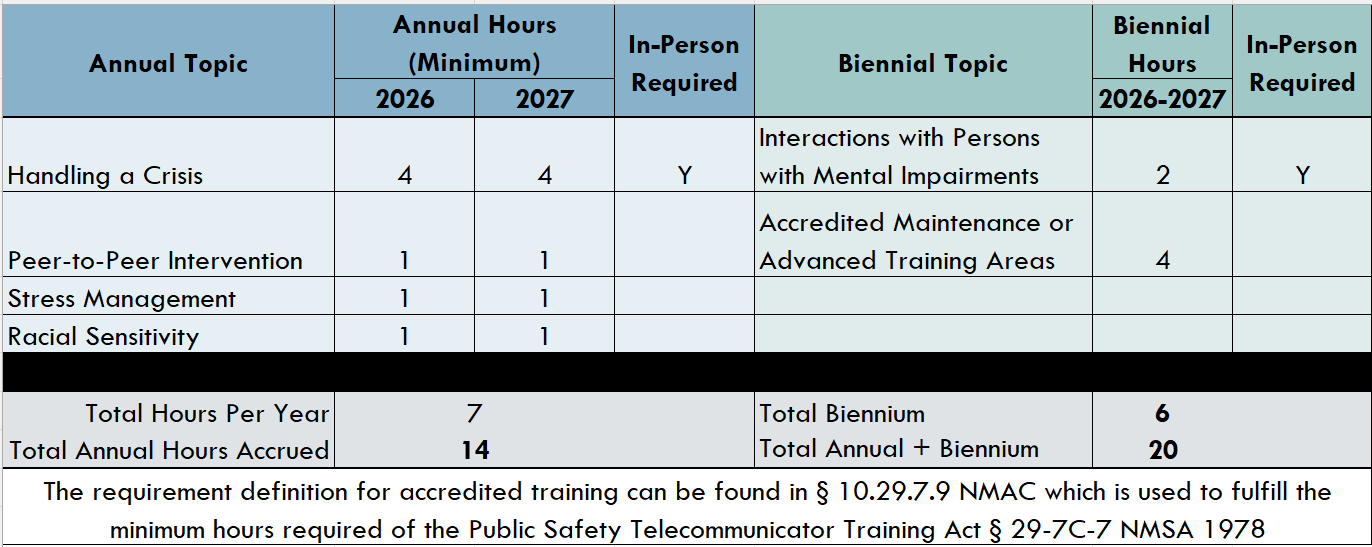
*In-Person denotes that the course MUST be taken in-person due to a component of the requirement for scenarios or practical application. Online courses will NOT count for these topics.
New Mexico Law Enforcement Academy Board and Council Accredited In-Service Curriculum
The following training documents are provided for agencies to use to provide the required in-service training courses mandated by NM State Statute and/or NMLEA Board Rules. Each course has an accompanying NMLEAB Accreditation number.
The following courses are developed to be taught in-person (except Use of Force) and cannot be taught virtually at this time. These courses can only be taught by certified instructors with topic-specific instructor credentials:
- Handling a Crisis (general AND mental health instructor credentials required)
- Interactions with Persons with Mental Impairments
- Firearms
- Use of Force (not in-person, but specific instructor credential)
- Tourniquet & Trauma Kit
Agencies or vendors may develop and submit their own curriculum for accreditation utilizing NMLEAB form LEAB-86. Attendance must be documented within 30-days of course date, using NMLEAB form LEAB-86b or by submission approval through the Acadis® Portal.
Annual In-Service Training Curriculum
10.29.7.8 IN-SERVICE TRAINING CYCLE FOR LAW ENFORCEMENT OFFICERS & Instructor Certifications required to teach the In-Service Training
A. All New Mexico certified law enforcement officers shall receive a minimum of 40 hours of training bi-annually (every other year). Each two year in-service training cycle will begin on the first day of the subsequent even numbered year and conclude on the final day of the sequential odd numbered year.
(1) A minimum of four hours training shall be in safe pursuit pursuant to Section 29-20-3 NMSA 1978. – General Instructor Certification
(2) A minimum of one hour training shall be in domestic violence incident training pursuant to Section 29-7-4.1 NMSA1978, annually. – Domestic Violence Instructor Certification
(3) A minimum of two hours training shall be in the detection, investigation and reporting of a crime motivated by hate pursuant to Subsection B of Section 31-18B-5 NMSA 1978. – General Instructor
(4) For all officers who may be involved in the arrest of driving while intoxicated (DWI) offenders as a normal part of their duties, four hours training shall be in NHTSA approved standardized field sobriety testing (SFST) protocols or successful course completion of the NHTSA approved 16 hour advanced roadside impaired driving enforcement course. – DWI/SFST Instructor Certification
(5) A minimum of one hour training shall be in ensuring child safety upon arrest pursuant to Section 29-7-7.3 NMSA 1978, annually. – General Instructor Certification
(6) Four hours training of academy approved day and night firearms training on agency approved weapons systems including, but not limited to, duty handgun, backup handgun, shotgun, and rifle. No more than one hour training shall be classroom lecture. A minimum of three hours training, divided equally between day and night training, and shall consist of practical exercises using live fire, Simmunitions®, Airsoft® or other firearms training systems. Qualification testing may not be used as training to meet this requirement. – Firearms Instructor Certification
(7) A minimum of two hours training in child abuse incident training pursuant to Section 29-7-4.2 NMSA 1978, annually. – General Instructor/Child Abuse Instructor Certification
(8) A minimum of one hour training shall be in missing persons and Amber alert training pursuant to Section 29-7-7.4 NMSA 1978, annually. – General Instructor Certification
(9) A minimum of two hours training shall be in academy accredited interaction with persons with mental impairments training pursuant to Section 29-7-7.5 NMSA 1978. – Interactions with Persons with Mental Impairments Instructor
(10) A minimum of 30 minutes training shall be in academy accredited tourniquet and trauma kit training pursuant to Section 29-7-7.7 NMSA 1978, annually. – Tourniquet and Trauma Kit Instructor Certification from Bleedingcontrol.org or FLETC as examples.
(11) A minimum of two hours training shall be in legal update training to include changes in New Mexico state statutes and recent state and federal case law. – Professional Lecturer as a Legal Instructor (Attorney)
(12) Remaining training hours shall be in maintenance or advanced areas to meet the agencies specific needs.
B. Required training may be received through the following means:
(1) Where scheduling will allow, the New Mexico law enforcement academy will assign staff to instruct the course at the academy and regional training sites.
(2) Curriculum developed by the New Mexico law enforcement academy will be provided to individual agencies upon request for their own certified instructors to present to their officers, provided the instructor is qualified in the subject matter.
(3) Individual agencies or private contractors may develop curriculum for review and approval (accreditation) by the academy which meets the criteria established by the board.
C. This three-pronged approach gives all agencies the flexibility they need to address individual training needs. It also allows the board to implement a planned program of in-service training that is responsive to the changing demands placed upon law enforcement and the opportunity to have statewide consistency in certain critical areas.
D. Implementation is to begin on January 1, of the first even numbered year of a training cycle.
E. Officers obtaining certification within an even numbered year will be required to obtain one-half of the in-service training requirements. Officers obtaining certification within an odd numbered year will be required to meet the next two-year in-service training requirement which will go into effect on January 1 of the succeeding even numbered year. The in-service training requirements are applicable in subsequent two-year cycles (one even number year and the subsequent odd numbered year constitutes a two-year cycle. Officers transferring from one agency to another will carry with them the responsibility for in-service training.
[10.29.7.8 NMAC – Rp, 10.29.7.8 NMAC, 07/10/2018]
TOPIC: Annual Child Abuse Training Documents
AUTHORITY:
A minimum of two (2) hours in child abuse incident training pursuant to §29-7-4.2 NMSA 1978.
RESOURCES:
COMPARABLE TRAINING:
Comparable training is alternate accredited curriculum that meets or exceeds the minimum standard of training of the NMLEA provided lesson plan above and will fulfill the In-Service/Biennium requirement as set forth in the training statutes. If a training or accreditation number is not listed below, then it will NOT fulfill the requirement and not be marked complete for compliance.
| Substitute Course Curriculum Template Name | Provider |
| Coming Soon! | |
TOPIC: Annual Domestic Violence Training Documents
AUTHORITY:
A minimum of one (1) hour shall be in domestic violence incident training pursuant to §29-7-4.1 NMSA 1978.
RESOURCES:
COMPARABLE TRAINING:
Comparable training is alternate accredited curriculum that meets or exceeds the minimum standard of training of the NMLEA provided lesson plan above and will fulfill the In-Service/Biennium requirement as set forth in the training statutes. If a training or accreditation number is not listed below, then it will NOT fufill the requirement and not be marked complete for compliance.
| Substitute Course Curriculum Template Name | Provider |
| NM260050 Domestic Violence | Vector Solutions |
TOPIC: Annual Ensuring Child Safety Upon Parental Arrest Training Documents
AUTHORITY:
A minimum of one (1) hour shall be in ensuring child safety upon arrest pursuant to §29-7-7.3 NMSA 1978.
COMPARABLE TRAINING:
Comparable training is alternate accredited curriculum that meets or exceeds the minimum standard of training of the NMLEA provided lesson plan above and will fulfill the In-Service/Biennium requirement as set forth in the training statutes. If a training or accreditation number is not listed below, then it will NOT fufill the requirement and not be marked complete for compliance.
| Substitute Course Curriculum Template Name | Provider |
TOPIC: Annual Handling a Crisis
AUTHORITY:
Pursuant to §29-7-4.4 NMSA 1978.
RESOURCES:
COMPARABLE TRAINING:
Comparable training is alternate accredited curriculum that meets or exceeds the minimum standard of training of the NMLEA provided lesson plan above and will fulfill the In-Service/Biennium requirement as set forth in the training statutes. If a training or accreditation number is not listed below, then it will NOT fulfill the requirement and not be marked complete for compliance.
| Substitute Course Curriculum Template Name | Provider |
| NM260029 NMSP Handling a Crisis through Crisis Management | NMSP |
| NM260027 Handling A Crisis | Southwest Training Consultants |
| NM260039 Crisis Communications Training | Total Response (formerly PowerPhone) |
TOPIC: Annual Missing Persons/AMBER Alert Training Documents
AUTHORITY:
A minimum of one (1) hour shall be in missing persons and AMBER alert training pursuant to §29-7-7.4 NMSA 1978.
RESOURCES:
Below are sample PowerPoint presentations and reference materials which may be used by law enforcement agencies to meet this mandate. The presentation has been accredited for two hours of in-service training.
COMPARABLE TRAINING:
Comparable training is alternate accredited curriculum that meets or exceeds the minimum standard of training of the NMLEA provided lesson plan above and will fulfill the In-Service/Biennium requirement as set forth in the training statutes. If a training or accreditation number is not listed below, then it will NOT fufill the requirement and not be marked complete for compliance.
| Substitute Course Curriculum Template Name | Provider |
| NM260048 Missing Persons | Vector Solutions |
TOPIC: Annual Peer to Peer Intervention
AUTHORITY:
Pursuant to §29-7-4.4 NMSA 1978.
RESOURCES:
- 2006 Peer to Peer Instructor LP – NM260004
- 2026 Peer-to-Peer Intervention (NM260004) PPT
- ABLE Fact Sheet
- Contact NMLEA for PowerPoint
COMPARABLE TRAINING:
Comparable training is alternate accredited curriculum that meets or exceeds the minimum standard of training of the NMLEA provided lesson plan above and will fulfill the In-Service/Biennium requirement as set forth in the training statutes. If a training or accreditation number is not listed below, then it will NOT fulfill the requirement and not be marked complete for compliance.
| Substitute Course Curriculum Template | Provider |
| Coming Soon! |
TOPIC: Annual Racial Sensitivity
AUTHORITY:
Pursuant to §29-7-4.4 NMSA 1978.
RESOURCES:
COMPARABLE TRAINING:
Comparable training is alternate accredited curriculum that meets or exceeds the minimum standard of training of the NMLEA provided lesson plan above and will fulfill the In-Service/Biennium requirement as set forth in the training statutes. If a training or accreditation number is not listed below, then it will NOT fulfill the requirement and not be marked complete for compliance.
| Substitute Course Curriculum Template | Provider |
| NM260018 Racial Profiling | Lexipol |
| NM260030 Racial Profiling | Lexipol |
TOPIC: Annual Stress Management
AUTHORITY:
Pursuant to §29-7-4.4 NMSA 1978.
RESOURCES:
COMPARABLE TRAINING:
Comparable training is alternate accredited curriculum that meets or exceeds the minimum standard of training of the NMLEA provided lesson plan above and will fulfill the In-Service/Biennium requirement as set forth in the training statutes. If a training or accreditation number is not listed below, then it will NOT fulfill the requirement and not be marked complete for compliance.
| Substitute Course Curriculum Template | Provider |
| NM260017 Officer Wellness & Mental Health Awareness | Lexipol |
| NM260028 Dealing with Stress | Lexipol |
| NM260031 Workplace Stress Resiliency | Lexipol |
| NM260032 Finding Wellness-Building a Healthier Life | Lexipol |
| NM260034 Officer Wellness & Mental Health Awareness | Lexipol |
| NM260037 Stress and Your Health | Lexipol |
| NM260046 Fundamentals of Stress 201 | Vector Solutions |
| NM260047 Patrol – Critical Incident Stress Management | Vector Solutions |
| NM260049 Health and Wellness in Public Safety | Vector Solutions |
TOPIC: Annual Tourniquet and Trauma Kit Training
AUTHORITY:
Pursuant to §29-7-7.7 NMSA 1978.
RESOURCES:
- 2026 Tourniquet & Trauma Kit / Stop the Bleed LP – NM260001
- 2026 Tourniquet and Trauma Kit / Stop the Bleed NM260001 Annual In-Service PPT
COMPARABLE TRAINING:
Comparable training is alternate accredited curriculum that meets or exceeds the minimum standard of training of the NMLEA provided lesson plan above and will fulfill the In-Service/Biennium requirement as set forth in the training statutes. If a training or accreditation number is not listed below, then it will NOT fulfill the requirement and not be marked complete for compliance.
| Substitute Course Curriculum Template | Provider |
| NM260016 2026- In-Service Tourniquet/Trauma Kit Tactical Medical Refesher | BCSO |
TOPIC: Annual Use of Force
AUTHORITY:
Pursuant to §29-7-4.4(H) NMSA 1978.
RESOURCES:
COMPARABLE TRAINING:
Comparable training is alternate accredited curriculum that meets or exceeds the minimum standard of training of the NMLEA provided lesson plan above and will fulfill the In-Service/Biennium requirement as set forth in the training statutes. If a training or accreditation number is not listed below, then it will NOT fulfill the requirement and not be marked complete for compliance.
| Substitute Course Curriculum Template | Provider |
| NM260033 NM Biennium: Use of Force | Lexipol |
| NM260040 Use of Force Legal Aspects – NM Annual | Tactical Legal Solutaions |
| NM260045 Use of Force | Lexipol/Police One Academy |
TOPIC: Annual Firearms Day/Night Qualification Courses
AUTHORITY:
Requalification scores of every law enforcement officer in the state of New Mexico shall be reported yearly to the New Mexico Law Enforcement Academy Board by the employing agency for the daytime, nighttime, and other applicable courses of fire pursuant to §10.29.9.14F(2) NMAC.
Requalification testing may not be used as training to meet the Biennial requirement.
RESOURCES:
Agencies must qualify their officers using the NMLEA Board approved Day and Night qualification courses.Officers are required to achieve a minimum passing score of 80% on a 100-point scale.
Shot point values for the NMLEA Board Day Pistol Qualification courses are worth two points each. Head shots can only be scored if they lay within the “Scuba Mask” on an approved NMLEAB target.
When reporting pistol scores, odd score values will be considered invalid, only even scores (i.e., 88, 90, 92) will be accepted.
The NMLEA Board Night Pistol Qualification course is a 25-shot course. Shot point values for the “New” NMLEA Board Night Pistol qualification course is worth 4 points each. Head shots can only be scored if they lay within the “Scuba Mask” on an approved NMLEAB target. When reporting scores, odd-number score values will be considered invalid, only even-number score values (i.e., 88, 90, 92) will be accepted.
Biennial In-Service Training Curriculum
TOPIC: Biennial Interaction with Persons with Mental Impairment
AUTHORITY:
A minimum of two (2) hours shall be in academy accredited interaction with persons with mental impairments training pursuant to 10.29.7.8A(9) NMAC.
RESOURCES:
Curriculum has been developed to meet the statutory requirements and Train-the-Trainer courses are being offered. All instructors who complete the Train -the-Trainer will be given the full curriculum to deliver the training to officers and telecommunicators state-wide. Please check the Advanced Training Schedule for dates and locations of classes.
- 2026-2027 Interactions with Mentally Impaired lesson plan
- Interactions with Persons with Mental Illness. In Person Part 1
- Interactions with Persons with Mental Illness. In Person Part 2
COMPARABLE TRAINING:
Comparable training is alternate accredited curriculum that meets or exceeds the minimum standard of training of the NMLEA provided lesson plan above and will fulfill the In-Service/Biennium requirement as set forth in the training statutes. If a training or accreditation number is not listed below, then it will NOT fulfill the requirement and not be marked complete for compliance.
| Substitute Course Curriculum Template | Provider |
| NM260042 Interactions with Person’s with Mental Illness Biennial Refresher Course | PSPG |
TOPIC: Biennial Safe Pursuit
AUTHORITY:
A minimum of four (4) hours training shall be in safe pursuit pursuant to Subsection E § 29-20-3, NMSA 1978.
RESOURCES:
COMPARABLE TRAINING:
Comparable training is alternate accredited curriculum that meets or exceeds the minimum standard of training of the NMLEA provided lesson plan above and will fulfill the In-Service/Biennium requirement as set forth in the training statutes. If a training or accreditation number is not listed below, then it will NOT fulfill the requirement and not be marked complete for compliance.
| Substitute Course Curriculum Template | Provider |
| Coming Soon! |
TOPIC: Biennial Hate Crimes
AUTHORITY:
A minimum of two (2) hours training shall be in the detection, investigation and reporting of a crime motivated by hate pursuant to Subsection B of § 31-18B-5 NMSA 1978.
RESOURCES:
COMPARABLE TRAINING:
Comparable training is alternate accredited curriculum that meets or exceeds the minimum standard of training of the NMLEA provided lesson plan above and will fulfill the In-Service/Biennium requirement as set forth in the training statutes. If a training or accreditation number is not listed below, then it will NOT fulfill the requirement and not be marked complete for compliance.
| Substitute Course Curriculum Template | Provider |
| Coming Soon! |
TOPIC: Biennial Legal Update
AUTHORITY:
A minimum of two (2) hours shall be in academy accredited legal update training to include changes in New Mexico State Statutes and recent state and federal case law pursuant to 10.29.7 NMAC.
RESOURCES:
COMPARABLE TRAINING:
Comparable training is alternate accredited curriculum that meets or exceeds the minimum standard of training of the NMLEA provided lesson plan above and will fulfill the In-Service/Biennium requirement as set forth in the training statutes. If a training or accreditation number is not listed below, then it will NOT fulfill the requirement and not be marked complete for compliance.
| Substitute Course Curriculum Template | Provider |
| NM260041 New Mexico Legal Update | Tactical Legal Solutaions |
TOPIC: Firearms Training
AUTHORITY:
Four (4) hours training of academy approved day and night firearms training on agency approved weapons systems pursuant to 10.29.7.8, § (A)(6), NMAC. Annual Requalification testing may not be used as training to meet the Biennial requirement.
RESOURCES:
Training curriculum for Law Enforcement Firearms is SECURITY SENSITIVE.
The Academy has drafted model curriculum for handgun to meet the 2026-2027 in-service training requirements. These NMLESTC accredited lesson plans are available to NMLESTC certified Firearms Instructors only. Firearms Instructors holding a current NMLEAB certification may contact the Deputy Director of Training to request a copy of firearms lesson plans.
Contact Info:
505-827-9252
nmleatraining@dps.nm.gov
As an alternative to the Academy courses, Departments may create their own courses to meet the 2024 – 2025 In-Service training requirements, however courses must be submitted to the Academy for accreditation to meet the in-service training requirements under 10.29.7 NMAC.
COMPARABLE TRAINING:
Comparable training is alternate accredited curriculum that meets or exceeds the minimum standard of training of the NMLEA provided lesson plan above and will fulfill the In-Service/Biennium requirement as set forth in the training statutes. If a training or accreditation number is not listed below, then it will NOT fulfill the requirement and not be marked complete for compliance.
| Substitute Course Curriculum Template | Provider |
| Coming Soon! |
TOPIC: Optional 2026-2027 In-Service Training Topics
AUTHORITY:
Remaining hours shall be in maintenance or advanced areas pursuant to 10.29.7.9, Paragraph A(2) and B(3), NMAC. (As of 2024-2025 cycle, this is only MANDATORY for Public Safety Telecommunicators who have four (4) un-assigned training hours required by §29-7c-7 NMSA 1978.
Other approved advanced and specialized training/education or any maintenance training area which is designed to improve upon or add to the knowledge, skills, and abilities of the certified public safety telecommunicator.
RESOURCES:
Upcoming NMLEA Training Opportunities
IADLEST Nationally Certified Training (MUST apply National Certification filter to results)